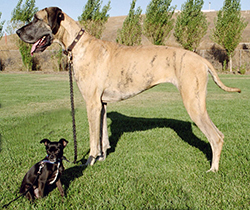
Amazingly, it takes many many generations of selectively breeding dogs to get a certain feature, attribute or skill, but those "chosen" genes may not be the most successful genes. A pure-bred dog's apprearance can be based on mostly recessive traits, such that they are easily "bred-out."
In other words- if you select and restrict a pool of dogs- they will eventually appear exactly the same over time. However, if you mix dogs all over the globe for generations and generations and introduce no selective breeding--they will tend to look similar and possess all dominant genes. (This is similar to the way blond hair and blue eyes in humans are said to be dying out because it is recessive.)
The DNA that allows dogs to be the most diverse species on the earth is unique to dogs, wolves and foxes. If you tried to breed a cow with short legs, or a bear with a curly tail- you would try and try and never achieve it. Dogs on the other hand have more genetic diversity even though they have 99.8% similar DNA - the difference between a 10 inch tall chihuahua and a 42 inch tall Great Dane is found only in 0.2%.
The reason is, dogs have long sections of DNA called 'Tandem repeats" that are extra unnecessary copies of genes and they are also very prone to mutation- allowing breeds to be developed in a relatively very short period of time. (
Read more here.)
In 1965 Genetics study by Scott & Fuller showed that when you breed two pure-bred parents-the resulting generations of dogs are increasingly diverse and look very little like each other or the original breeds.
For example, this Cocker Spaniel and Basenji had puppies that looked like neither of them:
Another generation later- even more variety was present:
Often times, shelters have no clue what to label a dog because even its litter-mates and parents could share few physical characteristics. According to Wisdom Panel, which is used to test DNA- if a dog has been mixed for three generations- there is no way to genetically determine the breeds in its ancestry. This is because breed markers (often recessive) are the first to go when breeds are mixed.
Pit bulls are the most diverse group of dogs- as they are not even a breed to begin with. It is possible that well-mixed populations of dogs tend to look like "pit bull type dogs." If you let dogs breed however they wanted for 3+ generations, what features would fade away? It is likely that extreme features/overly-shortened or elongated features would fade (very long or short coats, ears, legs, muzzles, tails and weight.)
DNA tests of mutts can reveal interesting trends (
read more here). Most likely because the number one place owners get their mutts is the shelter (46%), 9/10 mutts in the U.S.A. are spayed or neutered. This means that mixed genes are less likely than pure-bred genes to be passed on- preventing a real melting-pot of doggy-DNA from developing. Pure-bred dogs are less likely to be neutered. This is why mutt-DNA shows the popular breeds of the previous decades showing up in today's mutts rather than today's popular breeds. (For example, the Chow-Chow is the 63rd most popular breed by the 3rd most likely breed to show up in mutts because they were popular purebreds in the 1980s.)
However, because there is no real pit bull breed-the genetic pool is already diverse and getting more and more diverse with time. Our dog Bruno looks like a standard pit bull- but has no "Staffordshire" DNA (only dalmatian and poodle). On the other hand- our dog Winnie looks less like a standard pit bull, and has at least 25% Staffie DNA.
Because of this diverse genetic pool- it is hard to argue that all of these dogs have any commonalities at all- other than they are well-mixed and probably lack genetic diseases.This is important for potential-adopters to know, because labels can turn them off to great dogs. A research project done at Western University in Pomona showed that in 15 out of the 16 dogs, breeds were shown to be predominant that the shelters did not recognize, and that only 25% of the dogs identified as specified breed mixes were found correct by DNA. This is surprising because the dogs used in the study could have been better identified, even by appearance if the shelter staff had done a little more research or took a little more time-rather than simply labeling dogs "lab", "terrier" or "shepherd" mixes.

Labeling the dogs correctly could help them get adopted and lessen the stigma of the "pit bull." DNA tests are too difficult, and mixed dogs are too well-mixed to often even look like the breeds they come from. I think it may be best to simply call these shelter dogs "Mixed Breed" or "Multi-Breed" dogs, and leave it to the adopters to determine for themselves if they like what they see. Maybe labeling breeds does more harm than good.