Showing posts with label genetic results. Show all posts

Tuesday, June 5, 2012

Coat Color Genetics Revisited: White Coats

Last year, I wrote about the genetics of Brindle Coats (read more here.)

Here's what we learned: Dog coat color, shape, and length genetics are based in 16 specific locations of the geneome. The basic color loci are: Agouti Locus (A), Brown locus (B), Dilute locus (D), Extention locus (E), Harlequin locus (H), dominant black locus (K), Merle locus (M), and Spotting locus (S).

Still, this doesn't help the non-scientist understand the amazing differences you see among litter mates... well I recently discovered a little more information about white coats that is very interesting.

Just take a look at the litter from Smilin' Pit Bull Rescue that sweet, adoptable Mama-pittie Onyx delivered:
(Warning, cuteness overload below...)

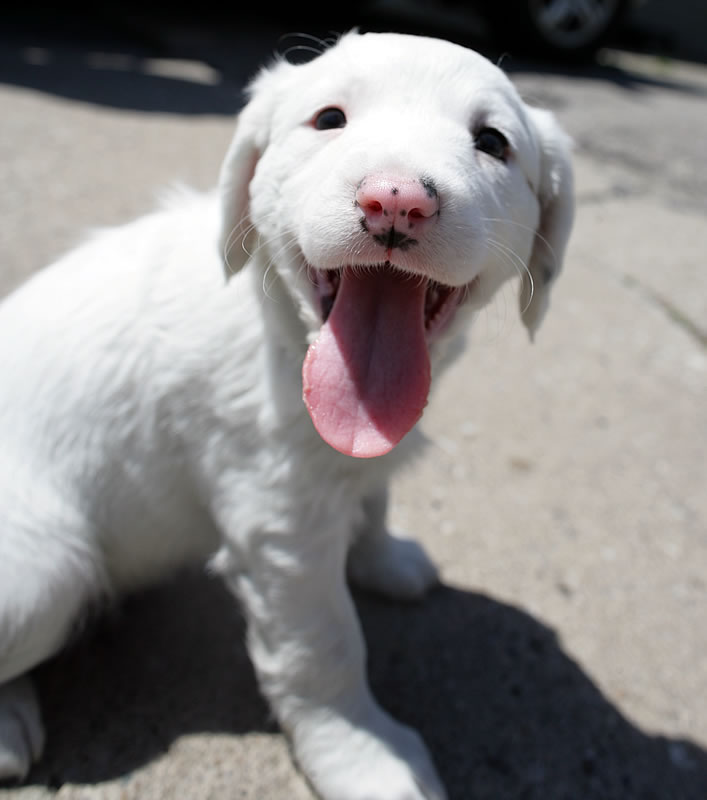
Onyx, a black short-haired pittie with white spots, had two all-white girls (1 short, 1 long haired), three all-black boys (2 short, 1 long haired), and 1 short-haired brown boy.

But how did a Black dog have pure white puppies? Well apparently the same genes that code for the extension of black and brown pigmentation over the body are present in white dogs, but white dogs are lacking the genes that turn ON the melanin production: ie, inject the hair with melanin from the hair folacle.

[See more pics and learn how you can adopt one of these Adora-bulls, here.]


Monday, September 12, 2011

Animal Farm Foundation Slideshow

PETsMART offered a phone/web based training on Pit Bull Adoption Basics/Training hosted by Kim Wolf of the Animal Farm Foundation.

These are some of the interesting slides shared with the participants.... These are a great resource if you are trying to explain pit bulls to your friends and family.


Kim said...Only 2-10% of a dog's DNA determines his DNA, and yet we are using that very small amount as a predictor of behavior, which is arbirtary and incorrect.
Don't imply more than you know or use terms incorrectly. Example, for a dog to be a bait dog- there has to be an aggressor dog, which is not a good image to conjure in adopters minds about pit bulls. Also, terriers tend to be "tenacious", but "pit bulls type dogs" can be lazy.

Don't imply more than you know- just because a dog barks at all brown dogs, doesn't mean it cannot be in a home with a brown dog. Fact: It is better to transfer ownership and get the dog back through legal channels if something goes wrong, rather than loaning the dog first- which opens you up to liability as a shelter or organization.

Having a separate area or policy for pit bull dogs sets the potential adopters up to think that pit bulls are different. You as the advocate should not create unnecessary fear. We should not assume anything about a dog's behavior from its arbitrary label.
There can be an unlikely match where you least expect it! Take time to get to know the potential homes.
Animal Farm Foundation does not give people a list of what may go wrong because they feel that they cannot list a comprehensive list of "what ifs".  People with children between 5-17 acquire 75% of dogs at any given time, so age-restrictions automatically restrict the adopter pool to 25%.


Advice from AFF to Shelters/Rescue Groups:

1) Place them next to a variety of dogs, don't segregate.
2) Put a friendly pit bull in your lobby as a greeter with a bandana!
3) Teach the dogs parlour tricks (pray, handshake, roll over, blow kisses)
4) Use enrichment toys to keep pits quieter and busier- they will present better to adopters
5) Think of your adopter as a customer-make the environment calm, cool and peaceful
6) Use playgroups to burn energy, learn more about the dog's personality, and engage volunteers
7) Have Rescue Brunches - invite local rescue groups and foster homes to watch play groups to pick dogs based on observation.
8) Some dogs do best with a job (agilty, disc, obedience, police, search and rescue, assistance, therapy)
9) Happiness Sells, Sadness repells. (Adoptions increase when you focus on the human/canine bond.)
10) Take pictures with other dogs or people, create a scene or tell a story, take pictures in front of landmarks or in costumes, even a hand or foot of a person in a picture increases the dog's chances of getting adopted. Take videos!
11) Use adopt me vests
12) Use business Cards
13) Don't forget the bling! (Cute tags, collars, bandanas!)
14) Don't forget the Elder dogs, they can be great additions to homes for years to come
15) Promote your staff that live with pit bulls to show you believe what you are selling
16) Promote your shelter as an "adoption option" rather than individual dogs.


Monday, May 16, 2011

Pit Bulls + Science

Amazingly, it takes many many generations of selectively breeding dogs to get a certain feature, attribute or skill, but those "chosen" genes may not be the most successful genes. A pure-bred dog's apprearance can be based on mostly recessive traits, such that they are easily "bred-out."

In other words- if you select and restrict a pool of dogs- they will eventually appear exactly the same over time. However, if you mix dogs all over the globe for generations and generations and introduce no selective breeding--they will tend to look similar and possess all dominant genes. (This is similar to the way blond hair and blue eyes in humans are said to be dying out because it is recessive.)

The DNA that allows dogs to be the most diverse species on the earth is unique to dogs, wolves and foxes. If you tried to breed a cow with short legs, or a bear with a curly tail- you would try and try and never achieve it. Dogs on the other hand have more genetic diversity even though they have 99.8% similar DNA - the difference between a 10 inch tall chihuahua and a 42 inch tall Great Dane is found only in 0.2%.
The reason is, dogs have long sections of DNA called 'Tandem repeats" that are extra unnecessary copies of genes and they are also very prone to mutation- allowing breeds to be developed in a relatively very short period of time. (Read more here.)

In 1965 Genetics study by Scott & Fuller showed that when you breed two pure-bred parents-the resulting generations of dogs are increasingly diverse and look very little like each other or the original breeds.
For example, this Cocker Spaniel and Basenji had puppies that looked like neither of them:

Another generation later- even more variety was present:

Often times, shelters have no clue what to label a dog because even its litter-mates and parents could share few physical characteristics. According to Wisdom Panel, which is used to test DNA- if a dog has been mixed for three generations- there is no way to genetically determine the breeds in its ancestry. This is because breed markers (often recessive) are the first to go when breeds are mixed.

Pit bulls are the most diverse group of dogs- as they are not even a breed to begin with. It is possible that well-mixed populations of dogs tend to look like "pit bull type dogs." If you let dogs breed however they wanted for 3+ generations, what features would fade away? It is likely that extreme features/overly-shortened or elongated features would fade (very long or short coats, ears, legs, muzzles, tails and weight.)

DNA tests of mutts can reveal interesting trends (read more here). Most likely because the number one place owners get their mutts is the shelter (46%), 9/10 mutts in the U.S.A. are spayed or neutered. This means that mixed genes are less likely than pure-bred genes to be passed on- preventing a real melting-pot of doggy-DNA from developing. Pure-bred dogs are less likely to be neutered. This is why mutt-DNA shows the popular breeds of the previous decades showing up in today's mutts rather than today's popular breeds. (For example, the Chow-Chow is the 63rd most popular breed by the 3rd most likely breed to show up in mutts because they were popular purebreds in the 1980s.)

However, because there is no real pit bull breed-the genetic pool is already diverse and getting more and more diverse with time. Our dog Bruno looks like a standard pit bull- but has no "Staffordshire" DNA (only dalmatian and poodle). On the other hand- our dog Winnie looks less like a standard pit bull, and has at least 25% Staffie DNA.

Because of this diverse genetic pool- it is hard to argue that all of these dogs have any commonalities at all- other than they are well-mixed and probably lack genetic diseases.This is important for potential-adopters to know, because labels can turn them off to great dogs. A research project done at Western University in Pomona showed that in 15 out of the 16 dogs, breeds were shown to be predominant that the shelters did not recognize, and that only 25% of the dogs identified as specified breed mixes were found correct by DNA. This is surprising because the dogs used in the study could have been better identified, even by appearance if the shelter staff had done a little more research or took a little more time-rather than simply labeling dogs "lab", "terrier" or "shepherd" mixes.


(Take a closer look at all of the sample dogs)

Labeling the dogs correctly could help them get adopted and lessen the stigma of the "pit bull." DNA tests are too difficult, and mixed dogs are too well-mixed to often even look like the breeds they come from. I think it may be best to simply call these shelter dogs "Mixed Breed" or "Multi-Breed" dogs, and leave it to the adopters to determine for themselves if they like what they see. Maybe labeling breeds does more harm than good.

Thursday, November 18, 2010

pit-MIX

The great thing about pitbulls it their genetic diversity. People don't realize it but most dog breeds look 95% alike (think of all the Golden Retrievers or yellow Labs you have ever seen.) But since Pit Bulls have been allowed to breed at a faster rate and make up a large portion of the stray population, pit mixes can be not only extremely genetically healthy but so interesting to own. Think about it, pit mixes can be any color, any size, but they all have that loving wiggeling charm and loyalty about them.

We had our dog Winnie tested when we first got her; (see image below) it said that she was 25% Staffordshire terrier and some parts Toy Fox Terrir, Bulldog, Chowchow and Rottwieler. Not sure how much I trust it, but we're pretty sure she's a Pitador/Labrabull, at least she looks/acts that way. I found out recently that she came all alone with a rescue from Georgia to Animal Haven in Soho (I have all along thought that she was part of a litter rescued from a puppy mill in Missouri).


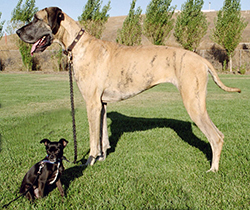
I had assumed Bruno was all pitty, not knowing what a 100% pit bull would even look like, I came across a Brindle-colored Great Dane on the web and decided that Bruno HAS to be part dane-- I see it mostly in the coloring, the dark black leathery lips and the giant head and long neck, but see for yourselves. Do you agree?


Related Posts Plugin for WordPress, Blogger...