Showing posts with label genetic disease. Show all posts

Monday, May 16, 2011

Pit Bulls + Science

Amazingly, it takes many many generations of selectively breeding dogs to get a certain feature, attribute or skill, but those "chosen" genes may not be the most successful genes. A pure-bred dog's apprearance can be based on mostly recessive traits, such that they are easily "bred-out."

In other words- if you select and restrict a pool of dogs- they will eventually appear exactly the same over time. However, if you mix dogs all over the globe for generations and generations and introduce no selective breeding--they will tend to look similar and possess all dominant genes. (This is similar to the way blond hair and blue eyes in humans are said to be dying out because it is recessive.)

The DNA that allows dogs to be the most diverse species on the earth is unique to dogs, wolves and foxes. If you tried to breed a cow with short legs, or a bear with a curly tail- you would try and try and never achieve it. Dogs on the other hand have more genetic diversity even though they have 99.8% similar DNA - the difference between a 10 inch tall chihuahua and a 42 inch tall Great Dane is found only in 0.2%.
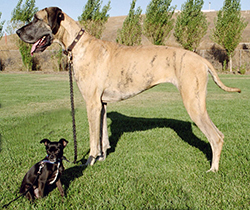
The reason is, dogs have long sections of DNA called 'Tandem repeats" that are extra unnecessary copies of genes and they are also very prone to mutation- allowing breeds to be developed in a relatively very short period of time. (Read more here.)

In 1965 Genetics study by Scott & Fuller showed that when you breed two pure-bred parents-the resulting generations of dogs are increasingly diverse and look very little like each other or the original breeds.
For example, this Cocker Spaniel and Basenji had puppies that looked like neither of them:

Another generation later- even more variety was present:

Often times, shelters have no clue what to label a dog because even its litter-mates and parents could share few physical characteristics. According to Wisdom Panel, which is used to test DNA- if a dog has been mixed for three generations- there is no way to genetically determine the breeds in its ancestry. This is because breed markers (often recessive) are the first to go when breeds are mixed.

Pit bulls are the most diverse group of dogs- as they are not even a breed to begin with. It is possible that well-mixed populations of dogs tend to look like "pit bull type dogs." If you let dogs breed however they wanted for 3+ generations, what features would fade away? It is likely that extreme features/overly-shortened or elongated features would fade (very long or short coats, ears, legs, muzzles, tails and weight.)

DNA tests of mutts can reveal interesting trends (read more here). Most likely because the number one place owners get their mutts is the shelter (46%), 9/10 mutts in the U.S.A. are spayed or neutered. This means that mixed genes are less likely than pure-bred genes to be passed on- preventing a real melting-pot of doggy-DNA from developing. Pure-bred dogs are less likely to be neutered. This is why mutt-DNA shows the popular breeds of the previous decades showing up in today's mutts rather than today's popular breeds. (For example, the Chow-Chow is the 63rd most popular breed by the 3rd most likely breed to show up in mutts because they were popular purebreds in the 1980s.)

However, because there is no real pit bull breed-the genetic pool is already diverse and getting more and more diverse with time. Our dog Bruno looks like a standard pit bull- but has no "Staffordshire" DNA (only dalmatian and poodle). On the other hand- our dog Winnie looks less like a standard pit bull, and has at least 25% Staffie DNA.

Because of this diverse genetic pool- it is hard to argue that all of these dogs have any commonalities at all- other than they are well-mixed and probably lack genetic diseases.This is important for potential-adopters to know, because labels can turn them off to great dogs. A research project done at Western University in Pomona showed that in 15 out of the 16 dogs, breeds were shown to be predominant that the shelters did not recognize, and that only 25% of the dogs identified as specified breed mixes were found correct by DNA. This is surprising because the dogs used in the study could have been better identified, even by appearance if the shelter staff had done a little more research or took a little more time-rather than simply labeling dogs "lab", "terrier" or "shepherd" mixes.


(Take a closer look at all of the sample dogs)

Labeling the dogs correctly could help them get adopted and lessen the stigma of the "pit bull." DNA tests are too difficult, and mixed dogs are too well-mixed to often even look like the breeds they come from. I think it may be best to simply call these shelter dogs "Mixed Breed" or "Multi-Breed" dogs, and leave it to the adopters to determine for themselves if they like what they see. Maybe labeling breeds does more harm than good.

Thursday, April 7, 2011

Funky Mixes in the USA

Hello bloggies--Strut your Mutts!

I was inspired by some of the beautiful mixed breed dogs in my neighborhood to highlight the mixed-breed dogs in shelters-
Mixed breeds have a lot going for them:
1) They are unique
2) They are less prone to genetic diseases
3) You will get lots of questions about them, which helps you make more friends
4) They are often really beautiful combinations of other breeds
5) You won't have to own a "pure-bred"- sorry if you have one (my parents have a "pure-bred" Wheaton terrier) but people who use the word pure-bred as if it matters or somehow makes their dog better than mine  really bother me.
6) You get to do their DNA tests, which is fun

So I decided to highlight some funky and beautiful mixed dogs available for adoption!


Max- A Rhodesian/Lab Mix in New York


Honey - A Blood hound and lab mix in Liberty Center, OH


Scrappy - a Wheaton Terrier and Border Terrier in Chicago


Strauss- an Afghan Hound/ Smooth Collie mix in Atlanta


Basil - a Basset Hound Pit Mix in Chicago

Miniature Pit-bull anyone?
Beacon - a smooth coated Chihuahua and Pit Bull Terrier in Los Angeles


Monday, December 13, 2010

Scary Vet Trip

On Friday night, my boyfriend and I closed the bedroom door and went to bed. We usually let the dogs into the bedroom, but we decided that they were happy outside and we were trying to set up some boundaries in our apartment.

Bruno whined for a while but eventually we didn't hear him and assumed the two were sleeping happily. At 3:30 am, my boyfriend and I were woken up by more whimpering, and my boyfriend got up to go to the bathroom. When he opened the door he swore loudly and I jumped out of bed.

Bruno had gone to the bathroom and thrown up ALL over the apartment. We searched quickly and found that he had gotten into a bottle of pills that I had left on the dining room table and had eaten a whole box of jelly beans and destroyed a number of other things, including my earmuffs that I had brought less than 12 hours before.

We were terrified. I was convinced he was going to die because he had eaten so many pills. We called poison control and ran outside to get a cab to the emergency vet. When we got into the cab, the cabbie said a dog had just destroyed his cab and it was brand new. We said we'd be careful, and we had a roll of paper towels in my bag, but Bruno threw up again anyway, and the cabbie was outraged. Luckily he accepted $40 dollars and we made it to the vet.

When we got there we explained everything to the vet and she counted the max. number of pills he could have eaten and called poison control again. They didn't have to pump his stomach because he had thrown up so much already. Strangely, the vet said the pills weren't here biggest concern- if a human had ingested that many, they would have OD-ed, but dogs don't react the same way. The bigger concern, she said, was the jelly beans. Apparently that amount of concentrated sugar and high fructose corn syrup can cause the whole body to become dehydrated and cause the cells in the brain to rupture, which could have caused neurological damage. They pumped him full of fluids, so it looked like the had a giant hump on his back.

Due to costs, we had to decline the stomach x ray (Pitties have such deep chests, the vet couldn't even feel his stomach to check if it was distended) and luckily, he didn't need one because we walked him all the way home in the dark (the sun rose on the way) and he was in perfect spirits and everything was fine the next day.

The only good news (or bad news) that came from the experience was that we found out that Bruno has some sort of kidney or thyroid disease. We explained to the vet that he drinks a lot (and seeks out water in the tub/toilet/knocks over glasses to get at a drop of water), and after viewing his blood work, she said he has hypercalemia and probably PU/PD. We will have to get Vet insurance and take him to find out what is really wrong.

Vet bills are so prohibitively expensive. Our total bill came to over $600, but they recommended x-rays and keeping him for observation which would have brought the total to over $1500. Especially now that Bruno has health issues, we will have to get insurance, I just hope his PU/PD won't be a "pre-existing condition." It is really too bad that there are no Not-for-profit vet clinics for people who are trying to keep their pets but can't afford their care. So many dogs end up dying at the shelter because their owners cannot afford their vet bills and have to give them up.

Thursday, November 18, 2010

pit-MIX

The great thing about pitbulls it their genetic diversity. People don't realize it but most dog breeds look 95% alike (think of all the Golden Retrievers or yellow Labs you have ever seen.) But since Pit Bulls have been allowed to breed at a faster rate and make up a large portion of the stray population, pit mixes can be not only extremely genetically healthy but so interesting to own. Think about it, pit mixes can be any color, any size, but they all have that loving wiggeling charm and loyalty about them.

We had our dog Winnie tested when we first got her; (see image below) it said that she was 25% Staffordshire terrier and some parts Toy Fox Terrir, Bulldog, Chowchow and Rottwieler. Not sure how much I trust it, but we're pretty sure she's a Pitador/Labrabull, at least she looks/acts that way. I found out recently that she came all alone with a rescue from Georgia to Animal Haven in Soho (I have all along thought that she was part of a litter rescued from a puppy mill in Missouri).


I had assumed Bruno was all pitty, not knowing what a 100% pit bull would even look like, I came across a Brindle-colored Great Dane on the web and decided that Bruno HAS to be part dane-- I see it mostly in the coloring, the dark black leathery lips and the giant head and long neck, but see for yourselves. Do you agree?


Thursday, October 28, 2010

Stop Puppy-Mills!

Tell them to stop breeding!

100,000 Pitbulls die in shelters every year, but puppymills in Missouri and elsewhere continue to breed these animals and sell them to pet stores for a profit. Puppy mill pups often are bred and grow up in cramped cages. Many develop neurological disorders or have genetic diseases or other problems.

Missouri is home to 23% of the Puppy mills in the U.S., many dogs from Missouri are shipped out via the internet to unknowing buyers in other states. Many shelters resue pups from Missouri and bring them to other states for veterinary care and better homes (which is our my own precious Winnie came to find me through Animal Haven in Soho, NYC). However, there is finally a proposed bill to stop the cruel practice in Missouri, called Proposition 8 (the Puppy Mill Cruelty Prevention Act) which sets restrictions on the size of these commerical breeding facilities and provides the animals with more basic care.
See the add for Prop 8 below:


Please see the ASPCA's list of ways to help stop the puppy mills:

ASPCA- 10 ways to help
Related Posts Plugin for WordPress, Blogger...