Thank goodness for these people- it is so easy for people to move and leave the problem unsolved- they are fighting the city and bringing national attention to this. I really hope Snickers gets to go home to his mom and dad soon.
Read more.
Want to read about a pit bull named Hooch who was a search and rescue dog on 9/11? Click here.
Showing posts with label BSL. Show all posts
Friday, December 23, 2011
Monday, July 11, 2011
The History of the Pit Bull
Enjoy this Dog Files Documentary on the Pit Bull...
Share it with your friends, your families, your co-workers.
Labels:
awareness,
breed bias,
Breed Specific Legislation,
BSL,
video
Monday, May 16, 2011
Pit Bulls + Science
Amazingly, it takes many many generations of selectively breeding dogs to get a certain feature, attribute or skill, but those "chosen" genes may not be the most successful genes. A pure-bred dog's apprearance can be based on mostly recessive traits, such that they are easily "bred-out."
In other words- if you select and restrict a pool of dogs- they will eventually appear exactly the same over time. However, if you mix dogs all over the globe for generations and generations and introduce no selective breeding--they will tend to look similar and possess all dominant genes. (This is similar to the way blond hair and blue eyes in humans are said to be dying out because it is recessive.)
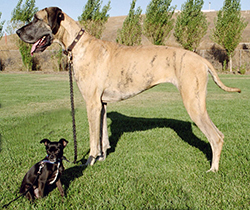
The DNA that allows dogs to be the most diverse species on the earth is unique to dogs, wolves and foxes. If you tried to breed a cow with short legs, or a bear with a curly tail- you would try and try and never achieve it. Dogs on the other hand have more genetic diversity even though they have 99.8% similar DNA - the difference between a 10 inch tall chihuahua and a 42 inch tall Great Dane is found only in 0.2%.
The reason is, dogs have long sections of DNA called 'Tandem repeats" that are extra unnecessary copies of genes and they are also very prone to mutation- allowing breeds to be developed in a relatively very short period of time. (Read more here.)
In 1965 Genetics study by Scott & Fuller showed that when you breed two pure-bred parents-the resulting generations of dogs are increasingly diverse and look very little like each other or the original breeds.
For example, this Cocker Spaniel and Basenji had puppies that looked like neither of them:
Often times, shelters have no clue what to label a dog because even its litter-mates and parents could share few physical characteristics. According to Wisdom Panel, which is used to test DNA- if a dog has been mixed for three generations- there is no way to genetically determine the breeds in its ancestry. This is because breed markers (often recessive) are the first to go when breeds are mixed.
Pit bulls are the most diverse group of dogs- as they are not even a breed to begin with. It is possible that well-mixed populations of dogs tend to look like "pit bull type dogs." If you let dogs breed however they wanted for 3+ generations, what features would fade away? It is likely that extreme features/overly-shortened or elongated features would fade (very long or short coats, ears, legs, muzzles, tails and weight.)
DNA tests of mutts can reveal interesting trends (read more here). Most likely because the number one place owners get their mutts is the shelter (46%), 9/10 mutts in the U.S.A. are spayed or neutered. This means that mixed genes are less likely than pure-bred genes to be passed on- preventing a real melting-pot of doggy-DNA from developing. Pure-bred dogs are less likely to be neutered. This is why mutt-DNA shows the popular breeds of the previous decades showing up in today's mutts rather than today's popular breeds. (For example, the Chow-Chow is the 63rd most popular breed by the 3rd most likely breed to show up in mutts because they were popular purebreds in the 1980s.)
However, because there is no real pit bull breed-the genetic pool is already diverse and getting more and more diverse with time. Our dog Bruno looks like a standard pit bull- but has no "Staffordshire" DNA (only dalmatian and poodle). On the other hand- our dog Winnie looks less like a standard pit bull, and has at least 25% Staffie DNA.
Because of this diverse genetic pool- it is hard to argue that all of these dogs have any commonalities at all- other than they are well-mixed and probably lack genetic diseases.This is important for potential-adopters to know, because labels can turn them off to great dogs. A research project done at Western University in Pomona showed that in 15 out of the 16 dogs, breeds were shown to be predominant that the shelters did not recognize, and that only 25% of the dogs identified as specified breed mixes were found correct by DNA. This is surprising because the dogs used in the study could have been better identified, even by appearance if the shelter staff had done a little more research or took a little more time-rather than simply labeling dogs "lab", "terrier" or "shepherd" mixes.
Labeling the dogs correctly could help them get adopted and lessen the stigma of the "pit bull." DNA tests are too difficult, and mixed dogs are too well-mixed to often even look like the breeds they come from. I think it may be best to simply call these shelter dogs "Mixed Breed" or "Multi-Breed" dogs, and leave it to the adopters to determine for themselves if they like what they see. Maybe labeling breeds does more harm than good.
In other words- if you select and restrict a pool of dogs- they will eventually appear exactly the same over time. However, if you mix dogs all over the globe for generations and generations and introduce no selective breeding--they will tend to look similar and possess all dominant genes. (This is similar to the way blond hair and blue eyes in humans are said to be dying out because it is recessive.)
The DNA that allows dogs to be the most diverse species on the earth is unique to dogs, wolves and foxes. If you tried to breed a cow with short legs, or a bear with a curly tail- you would try and try and never achieve it. Dogs on the other hand have more genetic diversity even though they have 99.8% similar DNA - the difference between a 10 inch tall chihuahua and a 42 inch tall Great Dane is found only in 0.2%.
The reason is, dogs have long sections of DNA called 'Tandem repeats" that are extra unnecessary copies of genes and they are also very prone to mutation- allowing breeds to be developed in a relatively very short period of time. (Read more here.)
In 1965 Genetics study by Scott & Fuller showed that when you breed two pure-bred parents-the resulting generations of dogs are increasingly diverse and look very little like each other or the original breeds.
For example, this Cocker Spaniel and Basenji had puppies that looked like neither of them:
Another generation later- even more variety was present:
Pit bulls are the most diverse group of dogs- as they are not even a breed to begin with. It is possible that well-mixed populations of dogs tend to look like "pit bull type dogs." If you let dogs breed however they wanted for 3+ generations, what features would fade away? It is likely that extreme features/overly-shortened or elongated features would fade (very long or short coats, ears, legs, muzzles, tails and weight.)
DNA tests of mutts can reveal interesting trends (read more here). Most likely because the number one place owners get their mutts is the shelter (46%), 9/10 mutts in the U.S.A. are spayed or neutered. This means that mixed genes are less likely than pure-bred genes to be passed on- preventing a real melting-pot of doggy-DNA from developing. Pure-bred dogs are less likely to be neutered. This is why mutt-DNA shows the popular breeds of the previous decades showing up in today's mutts rather than today's popular breeds. (For example, the Chow-Chow is the 63rd most popular breed by the 3rd most likely breed to show up in mutts because they were popular purebreds in the 1980s.)
However, because there is no real pit bull breed-the genetic pool is already diverse and getting more and more diverse with time. Our dog Bruno looks like a standard pit bull- but has no "Staffordshire" DNA (only dalmatian and poodle). On the other hand- our dog Winnie looks less like a standard pit bull, and has at least 25% Staffie DNA.
Because of this diverse genetic pool- it is hard to argue that all of these dogs have any commonalities at all- other than they are well-mixed and probably lack genetic diseases.This is important for potential-adopters to know, because labels can turn them off to great dogs. A research project done at Western University in Pomona showed that in 15 out of the 16 dogs, breeds were shown to be predominant that the shelters did not recognize, and that only 25% of the dogs identified as specified breed mixes were found correct by DNA. This is surprising because the dogs used in the study could have been better identified, even by appearance if the shelter staff had done a little more research or took a little more time-rather than simply labeling dogs "lab", "terrier" or "shepherd" mixes.
(Take a closer look at all of the sample dogs)
Labeling the dogs correctly could help them get adopted and lessen the stigma of the "pit bull." DNA tests are too difficult, and mixed dogs are too well-mixed to often even look like the breeds they come from. I think it may be best to simply call these shelter dogs "Mixed Breed" or "Multi-Breed" dogs, and leave it to the adopters to determine for themselves if they like what they see. Maybe labeling breeds does more harm than good.
Labels:
breed bias,
bruno,
BSL,
d,
dna test,
genetic disease,
genetic results,
genetic testing,
mixed breeds,
pit bulls,
shelter
Monday, May 9, 2011
Apartment Hunting
Finding a place to live (that you don't own) while having mixed breed dogs it notoriously difficult. Apparently if your dog is not a pure-bred, and appears to have genetic material from a long list of banned dogs-you cannot live in many places.
Below I've posted a ridiculous conversation I had with a renting agent at a apartment/condo community in central NJ. Apparently any percentage of the banned breeds disqualifies your dog- how they determine this is beyond me. So many mutts from shelters are chow/shepherd/staffie mutts- so they are really cutting out a huge dog population.
Christina: Thank you for contacting our community! How are you doing today?
Jessica: Hello
Jessica: My fiance and I are looking for an apartment/condo halfway between NYC and Philadelphia because he will be attending law school in the fall and I work in a law firm in NYC.
Jessica: is someone there?
Christina: Ok great Jessica! We are located _________, And I see your question here
Christina: We do allow mixed breed depending on the breeds. What type of dog do you have?
Jessica: Yes--We have two mixed-breed dogs (about 45 lbs each) that we rescued from NYC shelters- they are as sweet as can be but have features that to some resemble pit-mixes. They are super friendly-- We are extremely responsible dog-owners (both are fixed and 100% obedient)-and our dogs are better trained than all of the smaller dogs in our NYC neighborhood.
Christina: We do have certain breed restrictions so we will need to know what breeds your dogs is before we can approve him/her. Just so we are clear about the policy, we cannot accept the following breeds (whether purebred or mixed of any percentage-no exceptions): Akita, American Staffordshire Terrier, Bull Terrier, Chow, Doberman, German Shepherd, Husky, Pit Bull, Presa Canario, Rottweiler and Wolf Hybrid.
Jessica: we have had their DNA tested and they mostly mutts--one is less than 25% dalmation and the other is mostly labrador- but they look somewhat like pit bulls
Jessica: i can send a picture/
Jessica: but its hard to determine their "breeds" because they are so well-mixed
Jessica: they are suuuper sweet and everyone loves them
Christina: We would require documentation in regards to their breeds. If they are any of the breeds listed earlier then unfortunately we wouldn't be able to approve them.
Jessica: ok- so every dog needs a DNA test to be approved?
Christina: We would need documentation from a vet in order to approve them. Would that work for you?
...I said yes, but no vet would say our dogs are a Lab and a Plott Hound.. so se la vie!!
Below I've posted a ridiculous conversation I had with a renting agent at a apartment/condo community in central NJ. Apparently any percentage of the banned breeds disqualifies your dog- how they determine this is beyond me. So many mutts from shelters are chow/shepherd/staffie mutts- so they are really cutting out a huge dog population.
Christina: Thank you for contacting our community! How are you doing today?
Jessica: Hello
Jessica: My fiance and I are looking for an apartment/condo halfway between NYC and Philadelphia because he will be attending law school in the fall and I work in a law firm in NYC.
Jessica: is someone there?
Christina: Ok great Jessica! We are located _________, And I see your question here
Christina: We do allow mixed breed depending on the breeds. What type of dog do you have?
Jessica: Yes--We have two mixed-breed dogs (about 45 lbs each) that we rescued from NYC shelters- they are as sweet as can be but have features that to some resemble pit-mixes. They are super friendly-- We are extremely responsible dog-owners (both are fixed and 100% obedient)-and our dogs are better trained than all of the smaller dogs in our NYC neighborhood.
Christina: We do have certain breed restrictions so we will need to know what breeds your dogs is before we can approve him/her. Just so we are clear about the policy, we cannot accept the following breeds (whether purebred or mixed of any percentage-no exceptions): Akita, American Staffordshire Terrier, Bull Terrier, Chow, Doberman, German Shepherd, Husky, Pit Bull, Presa Canario, Rottweiler and Wolf Hybrid.
Jessica: we have had their DNA tested and they mostly mutts--one is less than 25% dalmation and the other is mostly labrador- but they look somewhat like pit bulls
Jessica: i can send a picture/
Jessica: but its hard to determine their "breeds" because they are so well-mixed
Jessica: they are suuuper sweet and everyone loves them
Christina: We would require documentation in regards to their breeds. If they are any of the breeds listed earlier then unfortunately we wouldn't be able to approve them.
Jessica: ok- so every dog needs a DNA test to be approved?
Christina: We would need documentation from a vet in order to approve them. Would that work for you?
...I said yes, but no vet would say our dogs are a Lab and a Plott Hound.. so se la vie!!
Tuesday, April 19, 2011
Save Our Breed
I hate the fact that a dog born as a pit bull has been born into a life of prejudice, fear, and abuse. People are so scared of Bruno- which makes him scared of them. He lives his life in fear of people because he knows they can and have hurt him. We have recently stopped allowing him to sleep in the bed with us (he is a big boy now)- but he still sits by the bed and whimpers for human contact- to snuggle under the covers and keep us warm.
These dogs have so much loyalty, bravery, love and forgiveness for humans that they should be heroes- they have the potential other breeds may not to do search and rescue, bomb sniffing, to save people, to comfort people, to change lives. They have a spark of life and a gift of strength and loyalty that a lot of breeds lack. Unfortunately, they are also the most likely breed of dog to endure animal abuse and the number one breed killed in animal shelters.
This first video is hard to watch but it really helps show how abused this breed really is- how these dogs didn't ask to be born scary and used for sport- they were born soft and cuddly like any dog. They deserve so much more from the people that bring them into this world.
Pit-bull ownership is not easy- having a dog that looks anything like pitty means you often can't rent an apartment (more on this later) or get home-owners' insurance or can't even live in certain jurisdictions- see the varying and ridiculous definitions here. (When else does a "I know it when I see it" description really hold up legally?)
But it is worth it-I would never abandon my dogs so that I could live in a specific place- they are a part of my family now and all I want for them is to be accepted enough that they don't have to be scared of strangers.
Looking forward to this Documentary:
These dogs have so much loyalty, bravery, love and forgiveness for humans that they should be heroes- they have the potential other breeds may not to do search and rescue, bomb sniffing, to save people, to comfort people, to change lives. They have a spark of life and a gift of strength and loyalty that a lot of breeds lack. Unfortunately, they are also the most likely breed of dog to endure animal abuse and the number one breed killed in animal shelters.
This first video is hard to watch but it really helps show how abused this breed really is- how these dogs didn't ask to be born scary and used for sport- they were born soft and cuddly like any dog. They deserve so much more from the people that bring them into this world.
Pit-bull ownership is not easy- having a dog that looks anything like pitty means you often can't rent an apartment (more on this later) or get home-owners' insurance or can't even live in certain jurisdictions- see the varying and ridiculous definitions here. (When else does a "I know it when I see it" description really hold up legally?)
But it is worth it-I would never abandon my dogs so that I could live in a specific place- they are a part of my family now and all I want for them is to be accepted enough that they don't have to be scared of strangers.
Looking forward to this Documentary:
Labels:
american pit bull terrier,
american staffordshire terrier,
BSL,
city council,
crime,
documentary,
dog fighting,
fear,
pit bull fighting,
resources,
video
Thursday, April 7, 2011
Funky Mixes in the USA
Hello bloggies--Strut your Mutts!
I was inspired by some of the beautiful mixed breed dogs in my neighborhood to highlight the mixed-breed dogs in shelters-
Mixed breeds have a lot going for them:
1) They are unique
2) They are less prone to genetic diseases
3) You will get lots of questions about them, which helps you make more friends
4) They are often really beautiful combinations of other breeds
5) You won't have to own a "pure-bred"- sorry if you have one (my parents have a "pure-bred" Wheaton terrier) but people who use the word pure-bred as if it matters or somehow makes their dog better than mine really bother me.
6) You get to do their DNA tests, which is fun
So I decided to highlight some funky and beautiful mixed dogs available for adoption!
Max- A Rhodesian/Lab Mix in New York
Honey - A Blood hound and lab mix in Liberty Center, OH
Scrappy - a Wheaton Terrier and Border Terrier in Chicago
Strauss- an Afghan Hound/ Smooth Collie mix in Atlanta
Basil - a Basset Hound Pit Mix in Chicago
Miniature Pit-bull anyone?
Beacon - a smooth coated Chihuahua and Pit Bull Terrier in Los Angeles
I was inspired by some of the beautiful mixed breed dogs in my neighborhood to highlight the mixed-breed dogs in shelters-
Mixed breeds have a lot going for them:
1) They are unique
2) They are less prone to genetic diseases
3) You will get lots of questions about them, which helps you make more friends
4) They are often really beautiful combinations of other breeds
5) You won't have to own a "pure-bred"- sorry if you have one (my parents have a "pure-bred" Wheaton terrier) but people who use the word pure-bred as if it matters or somehow makes their dog better than mine really bother me.
6) You get to do their DNA tests, which is fun
So I decided to highlight some funky and beautiful mixed dogs available for adoption!
Max- A Rhodesian/Lab Mix in New York
Honey - A Blood hound and lab mix in Liberty Center, OH
Scrappy - a Wheaton Terrier and Border Terrier in Chicago
Strauss- an Afghan Hound/ Smooth Collie mix in Atlanta
Beacon - a smooth coated Chihuahua and Pit Bull Terrier in Los Angeles
Labels:
a,
animal rescue,
breed bias,
BSL,
genetic disease,
genetic testing,
inbreeding,
mixed breeds,
shelter
Tuesday, November 30, 2010
How to be a good Pit-Bull owner
Let's face it- it is so hard to be a pit bull owner.
That problem gets multiplied when you have two.
Walking around New York City, it brings tears to my eyes to see people actively avoid Bruno by turning around, crossing the street, or waiting for another elevator.
It is especially difficult because of how well behaved he is-- He happens to be better at leash walking and more dog-friendly than our other dog, Winnie, but surprisingly, we never witnessed this prejudice with her. She looks more like a black lab and so people aren't immediately afraid, but Bruno's brindle pattern and large head make him look scary to others.
This past weekend we brought both of our dogs home for the holidays. It was one of the hardest experiences for me to watch him be so outcast without even being given a chance to show his sweet personality. While other dogs went into the house for dinner, it was implied that ours stay in the car- and then when it was too cold, stay on the leash inside. The problem is, keeping one dog on a leash while the others run around makes Bruno reasonably agitated and his barking doesn't help his cause. Finally, once we let him off the leash he got along with everyone and slept nicely under the table while we ate.
It was so hard for me to feel the prejudice that came from my & my boyfriends' families. My mother reacted like he would bite her our our family dog at any moment, even though he was completely docile and sleepy while he was there. I felt such pressure to defend him and felt attacked myself. The jokes and comments about him didn't help, but really hurt, like "for god's sake who would own a pit bull" and "I know Michael Vick, buddy!" and "He looks like he could eat my foot!" and "he has demon eyes!"
I couldn't ask for a better breed-ambassador, except for Bruno's intense fear of small boys (I have no idea where it comes from but he is really scared of little boys and will bark at them in a really scary way.) It was great to see everyone warm up to him at the end and allow him up on the couch to snuggle, and that made me hopeful, but so few people get to spend days with him and instead only make rash judgements based on his looks.
I know that every time he walks nicely on his leash and licks someone's hand when they go to pet him, that it gets better for him, but it doesn't seem to be a problem that is going to go away, and I just have to be more confident in my dogs and their friendliness.
It also doesn't hurt to be an educated pit bull owner. I know that people can get caught up in defending the breed, but the truth is that we have to be realistic. These dogs can have difficulty with other dogs and sometimes people. To protect the breed's reputation, you have to be proactive. Know your dog's short-comings. For example, when we see small children coming, we distract Bruno, have him sit, and reward him if he ignores them.
Ultimately, by being a proactive pit bull owner, you can help change the breed bias and that is ultimately what needs to happen before we can save pit bull lives.
Also, you have to protect your dogs from each other. We keep Bruno and Winnie separate during the day while we are at work and oversee all play time. We are currently training them to enjoy playing without teeth or growls. Getting a giant tug toy is actually a great way to distract their attention from each other's legs and neck and towards a toy. In fact, they get more energy out by chasing each other around and tugging than they do by constant wrestling.
For more resources on having a Multi-Dog Home, see Pit Bull Rescue Center's resources
They highlight that it is important to:
1) Know your dogs
2) Set them up to succeed
3) Train your dogs
4) Never leave them unsupervised with other animals
5) Spay and Neuter
6) Monitor Playtime
7) Always leash your dog
8) Avoid Off-Leash dog parks
9) Encourage early socialization
I recommend Tuffy's Ultimate Tug-of-War to get out some energy more productively:
That problem gets multiplied when you have two.
Walking around New York City, it brings tears to my eyes to see people actively avoid Bruno by turning around, crossing the street, or waiting for another elevator.
It is especially difficult because of how well behaved he is-- He happens to be better at leash walking and more dog-friendly than our other dog, Winnie, but surprisingly, we never witnessed this prejudice with her. She looks more like a black lab and so people aren't immediately afraid, but Bruno's brindle pattern and large head make him look scary to others.
This past weekend we brought both of our dogs home for the holidays. It was one of the hardest experiences for me to watch him be so outcast without even being given a chance to show his sweet personality. While other dogs went into the house for dinner, it was implied that ours stay in the car- and then when it was too cold, stay on the leash inside. The problem is, keeping one dog on a leash while the others run around makes Bruno reasonably agitated and his barking doesn't help his cause. Finally, once we let him off the leash he got along with everyone and slept nicely under the table while we ate.
It was so hard for me to feel the prejudice that came from my & my boyfriends' families. My mother reacted like he would bite her our our family dog at any moment, even though he was completely docile and sleepy while he was there. I felt such pressure to defend him and felt attacked myself. The jokes and comments about him didn't help, but really hurt, like "for god's sake who would own a pit bull" and "I know Michael Vick, buddy!" and "He looks like he could eat my foot!" and "he has demon eyes!"
I couldn't ask for a better breed-ambassador, except for Bruno's intense fear of small boys (I have no idea where it comes from but he is really scared of little boys and will bark at them in a really scary way.) It was great to see everyone warm up to him at the end and allow him up on the couch to snuggle, and that made me hopeful, but so few people get to spend days with him and instead only make rash judgements based on his looks.
I know that every time he walks nicely on his leash and licks someone's hand when they go to pet him, that it gets better for him, but it doesn't seem to be a problem that is going to go away, and I just have to be more confident in my dogs and their friendliness.
It also doesn't hurt to be an educated pit bull owner. I know that people can get caught up in defending the breed, but the truth is that we have to be realistic. These dogs can have difficulty with other dogs and sometimes people. To protect the breed's reputation, you have to be proactive. Know your dog's short-comings. For example, when we see small children coming, we distract Bruno, have him sit, and reward him if he ignores them.
Ultimately, by being a proactive pit bull owner, you can help change the breed bias and that is ultimately what needs to happen before we can save pit bull lives.
Also, you have to protect your dogs from each other. We keep Bruno and Winnie separate during the day while we are at work and oversee all play time. We are currently training them to enjoy playing without teeth or growls. Getting a giant tug toy is actually a great way to distract their attention from each other's legs and neck and towards a toy. In fact, they get more energy out by chasing each other around and tugging than they do by constant wrestling.
For more resources on having a Multi-Dog Home, see Pit Bull Rescue Center's resources
They highlight that it is important to:
1) Know your dogs
2) Set them up to succeed
3) Train your dogs
4) Never leave them unsupervised with other animals
5) Spay and Neuter
6) Monitor Playtime
7) Always leash your dog
8) Avoid Off-Leash dog parks
9) Encourage early socialization
I recommend Tuffy's Ultimate Tug-of-War to get out some energy more productively:
Thursday, October 28, 2010
Good Resources for Pit-Lovers!
Pit Bull Rescue Central - An amazing resource for more information
American Humane Association - Myths and Facts about APBT
Understand-A-Bull - A good website to learn about BSL (Breed Specific Legislation)Pit Bull Awareness Day - October 23
Find a Pit-Bull near you that needs a Home!
The Vick Dogs - Jim Gorant's Book about what happened to the tortured Vick dogs
Labels:
adoption,
american humane association,
animal control,
awareness,
Breed Specific Legislation,
BSL,
foster,
jim gorant,
michael vick,
pit bull,
pit bull fighting,
resources
Welcome!
Hello and Welcome to my blog to help save American Pitt Bull Terriers, American Staffordshire Terriers, and mixes from Euthanasia in the New York Metropolitan area.
Estimates are that 59% of dogs euthanized in the United States each year are Pitbulls or pit mixes. That comes to about 100,000 dogs killed every year.
Bias about this breeds agressiveness and BSL (Breed Specific Legislation) have kept these loyal and loving dogs from finding homes.
A study by the Center for Interaction of Animals and Society in 2008 found that certain breeds did score highly for agressiveness towards other animals and humans, speciaically Chihuahuas and Daschunds, and that Pit Bulls were only found to be slightly more agreesive than other breeds towards other dogs.
Any breed can be dog-agressive. Agressiveness towards other dogs should not preclude adoption, and doesn't. Only human-agressive dogs are euthanized, and as long as owners are responsible with their animals, dogs that show bad behaviors around other dogs can and should find loving one-pet homes.
There are hundreds of Pitt-specific resue groups, awareness groups, and even tv-shows to prove that this breed has won its way into the hearts of many humans and animals alike. Pit -mix owners know that the bias is unfounded and that the gentleness and loyalty of this enthusiastic breed is often used against it to encourage it to fight.
The pain and punishment this breed endures through the over-breeding, dog fighting, and euthanization is through no fault of its own. American society should reflect love and care for all people and animals that come into this world, especially if their plight is our own fault.
Please join me in my adventue to learn more about this breed and what can be done to save the lives of pitt-mixes in New York City shelters. Even if you are wary about this breed, it is an adventure worth taking. Who knows? Like me, you might find yourself waking up to kisses and tail wags from an adoring creature that cuddles up to you each night.
Estimates are that 59% of dogs euthanized in the United States each year are Pitbulls or pit mixes. That comes to about 100,000 dogs killed every year.
Bias about this breeds agressiveness and BSL (Breed Specific Legislation) have kept these loyal and loving dogs from finding homes.
A study by the Center for Interaction of Animals and Society in 2008 found that certain breeds did score highly for agressiveness towards other animals and humans, speciaically Chihuahuas and Daschunds, and that Pit Bulls were only found to be slightly more agreesive than other breeds towards other dogs.
Any breed can be dog-agressive. Agressiveness towards other dogs should not preclude adoption, and doesn't. Only human-agressive dogs are euthanized, and as long as owners are responsible with their animals, dogs that show bad behaviors around other dogs can and should find loving one-pet homes.
There are hundreds of Pitt-specific resue groups, awareness groups, and even tv-shows to prove that this breed has won its way into the hearts of many humans and animals alike. Pit -mix owners know that the bias is unfounded and that the gentleness and loyalty of this enthusiastic breed is often used against it to encourage it to fight.
The pain and punishment this breed endures through the over-breeding, dog fighting, and euthanization is through no fault of its own. American society should reflect love and care for all people and animals that come into this world, especially if their plight is our own fault.
Please join me in my adventue to learn more about this breed and what can be done to save the lives of pitt-mixes in New York City shelters. Even if you are wary about this breed, it is an adventure worth taking. Who knows? Like me, you might find yourself waking up to kisses and tail wags from an adoring creature that cuddles up to you each night.
Labels:
american pit bull terrier,
Amstaff,
animal rights,
APBT,
Breed Specific Legislation,
BSL,
dog,
euthanasia,
pit bull,
pits,
shelter
Subscribe to:
Posts (Atom)